

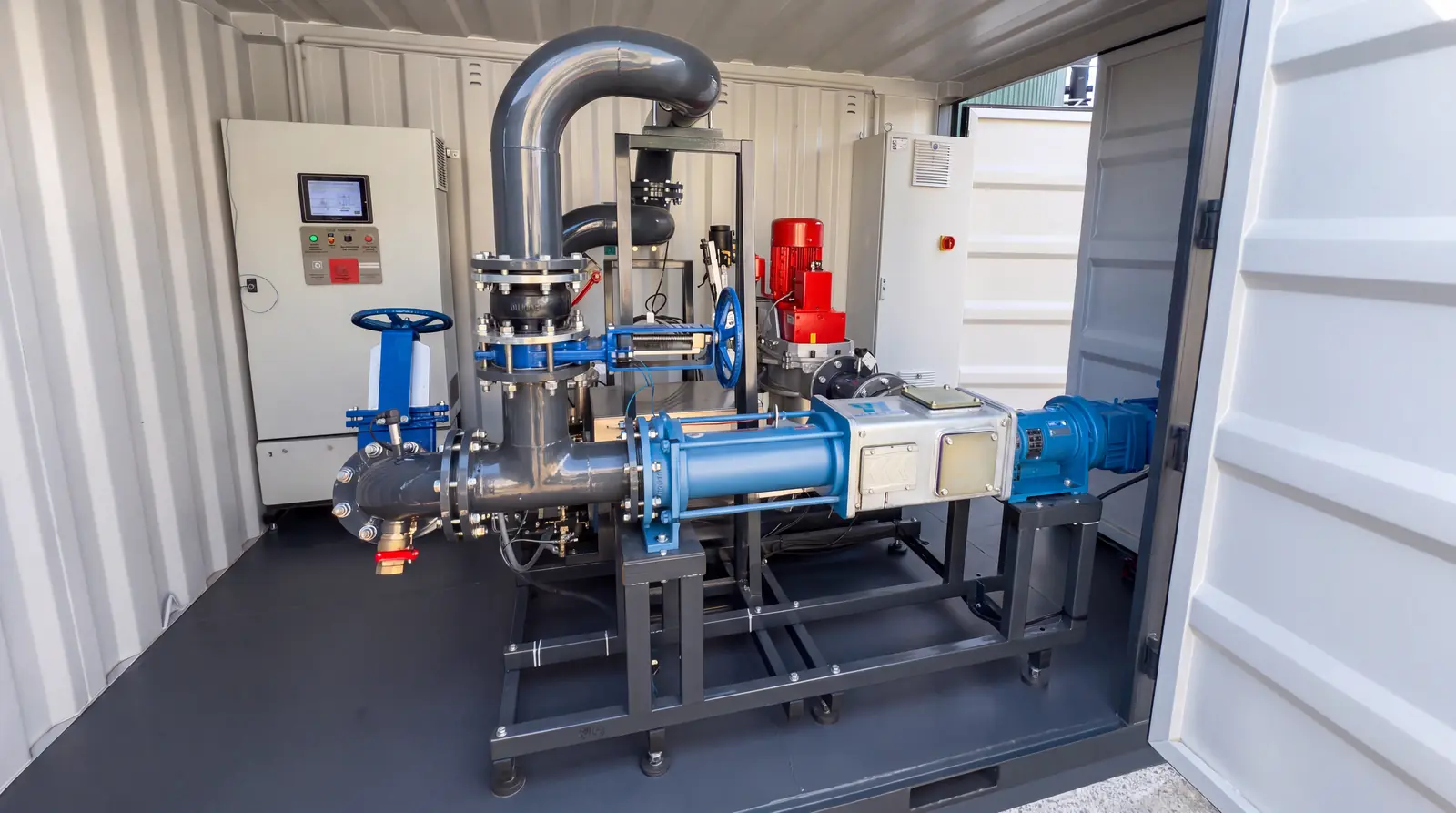
Mechanical substrate pre-treatment for existing plants
FaserMAX is a mechanical substrate pre-treatment system for biogas plants that breaks down grass, manure and maize fibres.
This produces more raw biogas from the same substrate. FaserMAX is manufactured by Biorganics Energy GmbH.
FaserMAX belongs to the first of the four modules in CleanCycle’s chain, biogas optimisation. The other modules are biomethane and bio-CNG, the certification and trading of the greenhouse gas reduction quota (GHG quota), and the use of CO₂ for algae.
In the chain, the optimisation comes first:
- Secure raw biogas: from your existing plant, optimised with FaserMAX and the CleanCycle Cube.
- Upgrade to biomethane: membrane upgrading to at least 97% methane.
- Compress and deliver: to 250–300 bar, by trailer to the hub – or into the grid where a grid injection point is nearby.
- Sell: bio-CNG as HGV fuel, together with the GHG quota.
Around 20% more gas – verified in a batch test with your own substrates
With FaserMAX, the same substrate produces around 20% more gas, verified in a batch test with your own substrates.
The figure of around 20% refers to FaserMAX. Alongside FaserMAX there is a second lever: the CleanCycle Cube.
With the option “Sell your raw biogas”, payment is per kWh of methane in the raw biogas: base price, higher price for high quality and volume. On the page “Sell your raw biogas”, a non-binding sample calculation for a 500 kW plant compares electricity via the tender with selling raw biogas to CleanCycle – without and with optimisation, before substrate costs, subject to the batch test.
How the batch test checks your substrates
In the batch test, CleanCycle measures the gas yield of your own substrates in the laboratory.
The site visit and batch test are the third of five steps:
- Plant questionnaire: you complete the plant questionnaire. Simply leave blank any fields you are unsure about.
- Initial assessment: we tell you which option fits.
- Site visit and batch test: we visit your plant and measure the gas yield of your own substrates in the laboratory.
- Concept and offer: every figure in the concept can be traced back to your plant’s substrate and process data.
- Contract and conversion: grid connection, implementation and commissioning.
The concept and offer are drawn up on the basis of the site visit and batch test. Only with them do we record the chosen option in a letter of intent – in other words, after the batch test.
The CleanCycle Cube controls the biology in the digester
The CleanCycle Cube is CleanCycle’s own measurement and control technology; it controls the biology in the digester.
Alongside FaserMAX, the Cube is the second lever of biogas optimisation – financed, operated and managed by CleanCycle.
The aim of the Cube is a higher methane content in the raw biogas.
Who finances FaserMAX
CleanCycle finances FaserMAX, upgrading and filling. If you feed into the gas grid, you bear the costs of the grid connection: the advance payment to the grid operator and your share of the connection costs. We will discuss the size of your share for your plant with you.
CleanCycle is not a plant manufacturer: CleanCycle develops the project, finances the technology, builds and operates the optimisation itself and sells the gas together with the GHG quota. CleanCycle carries the risk of the technology.
If you lease your plant, CleanCycle also finances FaserMAX, upgrading and filling. Whether you sell your raw biogas, lease your plant or sell it: in the initial assessment, we tell you which option suits your plant.
For operators whose support under Germany’s Renewable Energy Sources Act (EEG) is ending, the starting point is the Post-EEG Check, which is free and without obligation: five questions in four short steps – then CleanCycle will get back to you within 2 working days.
CleanCycle works with plants from 250 kW; smaller plants are bundled with neighbouring plants. The five questions of the Post-EEG Check:
- Does your EEG support end by 2032?
- Does your plant have 250 kW or more?
- Is there a gas pipeline nearby? If not, the gas is transported by trailer.
- Do you use slurry or manure? This significantly improves the greenhouse gas value (GHG value) of your gas.
- Do you want to continue operating, lease or sell?
Source on the GHG value of slurry and manure: Directive (EU) 2018/2001 (RED II), Annex VI, Part A, biomethane for transport